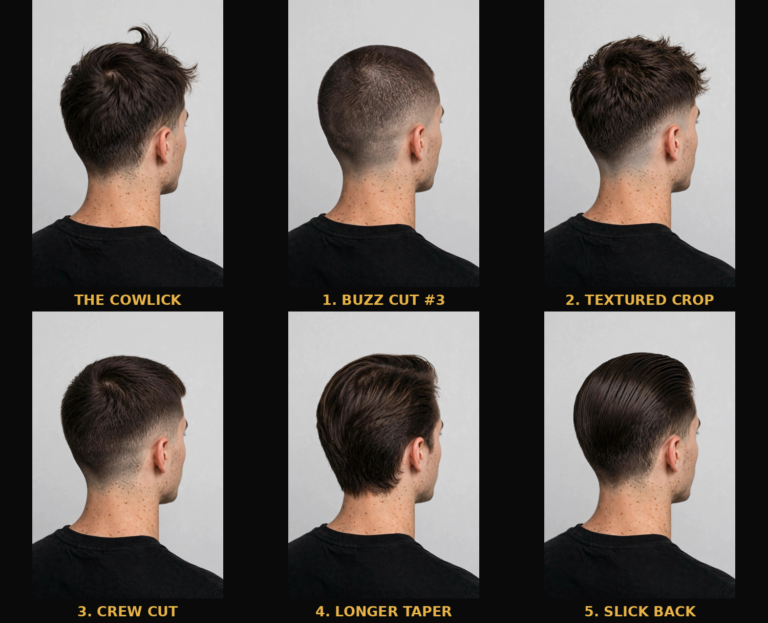
Fade Grow-Out Diary: What a Low Taper Fade Looks Like at Week 0, 1, 2, 3 and 4
Ask any barber how long a fade lasts and you will get a shrug and a number: “two, three weeks.” We wanted to see it — the exact week a fresh fade stops looking fresh.
So we took one low taper fade and grew it out week by week: Week 0, 1, 2, 3 and 4, same man, same angle, and scored each week honestly. One disclosure before the photos, because this site does not hide things: real time did not pass. Each week was rendered from the previous week’s photo at the real growth rate (about 2.5–3 mm per week — the method is explained at the end), then checked against how fades actually age. Here is the diary.
Week 0 — Fresh Out of the Chair (10/10)

This is the haircut at its peak: the taper is crisp, the hairline is sharp, the top is short and controlled. Every fade you have ever admired on Instagram is a Week 0 photo taken in the barber’s lighting. Remember that the next time a cut “doesn’t look like the picture” three weeks later — the picture was never a three-week-old haircut.
This exact cut is our Low Taper Fade prompt — preview it on your own photo free.
Week 1 — The Edges Go First (8/10)

One week, roughly 3 mm of growth — and look where it shows. Not the top. The edges: the hairline is a little softer, the taper around the ears a little less crisp. The shape is fully intact and nobody but you (and your barber) would notice. This is the week most men still call “fresh,” and they are almost right.
Week 2 — The Turning Point (6/10)

Week 2 is where the diary changes. The taper has blurred into the sides, the hair has real volume now, and the cut reads as “grown out” instead of “faded.” The shape is still there if you look for it, but it no longer announces itself.
The week-2 trick: this is the moment for an edge-up — a 10-minute line-up of the hairline, temples and neckline, without touching the rest. It does not restore the fade, but it restores the frame, and it honestly buys about one more presentable week. Many barbers offer it cheap or free between full cuts. Ask.
Week 3 — The Shape Is Gone (4/10)

By week 3 the diary is no longer about a fade. The sides have filled in, the hair covers the tops of the ears, and the head reads round instead of shaped. An edge-up cannot save this — there is no frame left to restore, because the blur is everywhere, not just at the edges. This is a haircut that has become just hair.
Week 4 — Expired (2/10)

A full month: the fade has completely dissolved into one uniform, grown-out mass. Nothing about it says “taper” anymore. The honest score is 2/10 as a fade — not because it looks terrible (grown-out hair looks fine on plenty of men), but because the thing you paid for no longer exists. If you book every 4 weeks, understand what you are buying: one great week, one good week, and two weeks of a different, softer look.
Why Fades Die So Fast (The Maths)
Scalp hair grows about half an inch (1.25 cm) per month — roughly 0.35–0.4 mm per day, or about 3 mm per week. Now think about what a fade is: a gradient from very short to longer. The shortest part of a taper might be 2–3 mm. One week of growth can double it. The gradient does not fade away slowly — it is mathematically destroyed from the bottom up, which is why the edges blur first.
That gives you the expiry rule for every cut:
- Skin fades expire fastest — the shortest point is 0 mm, so every day of growth shows. Prime life: about 1 week.
- Taper fades last a little longer — a softer gradient hides growth better. Prime life: 1–2 weeks, presentable to week 3 with an edge-up.
- Buzz cuts age the slowest — one even length grows out evenly, so there is no gradient to destroy. (See our buzz cut guide — a #3 still looks deliberate at week 3.)
- Scissor cuts age slowest of all — length hides growth; that is their whole trade-off against sharpness.
One more honest variable: this diary is on coily hair, whose curl hides a little growth. On straight hair the same 3 mm shows sooner, because straight hair sticks out where coily hair curls in. If your hair is straight, pull every score in this diary about half a week earlier.
The Booking Rule
- Want it to always look fresh? Book the full cut every 2 weeks, or every 3 weeks with a week-2 edge-up.
- Fine with the softer grown-out look? Every 3–4 weeks is honest — just know weeks 3–4 are a different style, not a faded one.
- Event coming (wedding, photos, interview)? Count backwards: get cut 2–4 days before, not the same morning — Week 0 day 2–3 is when a fade looks most natural.
FAQ
How long does a fade last?
At its best, about 1 week. Presentable for 2–3 weeks on a taper (less on a skin fade), especially with an edge-up at week 2. By week 4 the fade has fully grown out.
Does a skin fade grow out faster than a taper?
It does not grow faster — hair grows at the same speed — but it shows sooner. A skin fade’s shortest point is zero, so 3 mm of growth is a total change at the bottom of the gradient. A taper starts longer, so the same growth changes it less.
How can I make my fade last longer?
Book an edge-up at week 2, sleep with the hair protected (a durag or wave cap on coily hair reduces friction frizz), and do not try to re-fade your own neckline at home unless you know what you are doing — a bad home line-up is the one thing worse than a grown-out fade.
How We Made This Diary (Honesty Box)
The man in these photos is an AI-generated model — the same model as our Low Taper Fade prompt page, so no real person’s photos are used. Week 0 is the actual fresh-cut render from that page. Weeks 1–4 were generated one at a time, each from the previous week’s image, adding only the growth the American Academy of Dermatology’s average rate implies (about half an inch per month ≈ 3 mm per week). We rejected and re-rendered stages that jumped too far or changed the hairstyle — a diary where Week 4 looked neater than Week 3 would be a lie, and our first attempt did exactly that. The limit, stated plainly: this is a careful simulation of grow-out, not a camera following one man for a month; real hair also frizzes, flattens and misbehaves in ways a render smooths over. The timeline and the edges-first pattern match what barbers see in the chair.
Why You Can Trust This Diary
- First-hand: every image was made by BarberPing for this diary, in sequence, from one starting photo.
- Method shown: the growth rate, the chaining process, and the rejected renders are all disclosed above — including the failed first attempt.
- Real author: published under the site’s founder, Daniyal Khatri (see the author box below).
- Published: October 29, 2026. If we re-run this diary with new tools, this page will be updated and the date changed — never silently.
Growth-rate source: the American Academy of Dermatology’s average of about half an inch per month, as summarised in Dyson’s hair-growth science explainer. Maintenance advice (edge-ups, booking intervals) reflects standard professional barber practice — and where the photos and the practice could be compared, they agreed.
Founder of BarberPing. Daniyal builds free AI hairstyle prompts and guides that help men preview a haircut on their own photo before visiting the barber.